
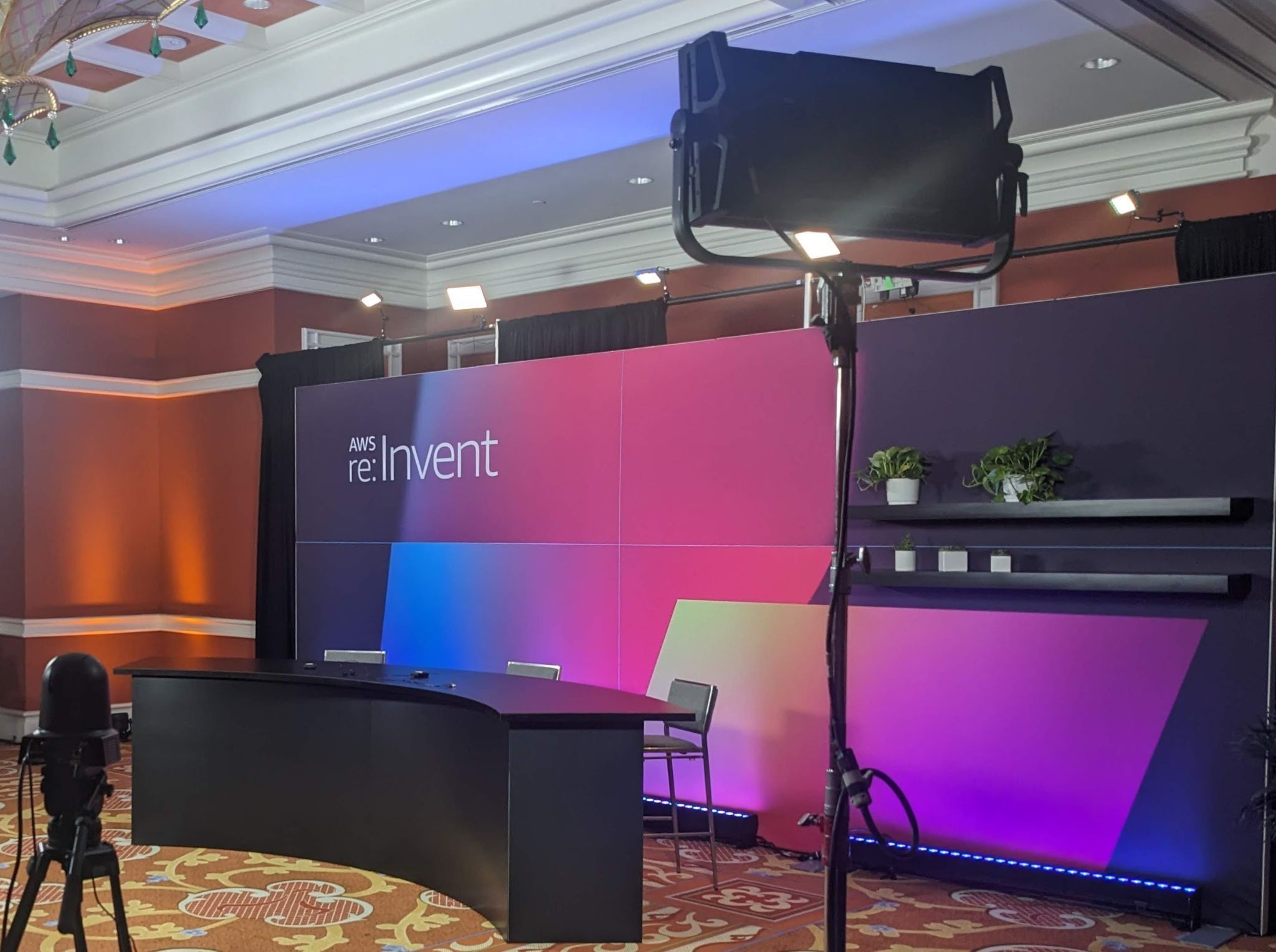
As is befitting the cloud platform that hosts about 30% of the internet, AWS re:Invent was massive. The conference, held this year in Las Vegas, hosted around 60,000 attendees over four days, and featured a slew of product announcements, networking events to wear your shaking hand down, and Beck.
I attended in person this year—my first—to see the sights, record podcasts (forthcoming), and talk to folks about what the future bodes. I watched some keynotes, attended press conferences, and worked the Expo floor to see who would talk. After the show, I reached out to a few organizations to see what they thought about it.
There was a lot of excitement and a little trepidation, plus millions of dollars of food and drink shoveled into the gullets of lucky developers.
AI: Agents, robots, and more
If you haven’t been living under a rock for the past year, the thing that everyone is talking about (and trying to sell) are agents. That trend, dear reader, will not be stopping just yet. Much of what was announced in the keynotes was around agents and AI.
The big one was the three frontier agents CEO Matt Garman announced in the first keynote. These are autonomous, pro-active AI agents that live with your application (in AWS, of course) and work for days at a time. These are the Kiro developer agent, a security agent, and a DevOps agent. They’ll work diligently in your EC2 clusters writing new code, finding security holes, and working frontline incident management.
Another agentic feature that got a big announcement—not in a keynote, mind—was their tech debt killer, AWS Transform. Instead, they announced it by dropping a server onto a pile of explosives at the Las Vegas fairgrounds. The server is the tech debt, and AWS Transform is the big yellow boxes labeled “Explosive.” Legacy software versions and systems are a significant blocker in enterprises, and AWS saved 6,500 years of developer time upgrading Java, so this one is worth watching.
Everybody’s building agents, not just AWS, and they are adding policy guardrails and evals to their Bedrock AgentCore service. Measuring and restricting the actions of agents is on the minds of everyone building agents (which, again, is everyone). “A single, standalone agent platform won’t deliver the vision of an agentic enterprise,” said Arnab Bose, Chief Product Officer at Asana. “The real value will come when agents can discover each other, share context, and collaborate across systems inside clear workflows, with identity, permissions, and guardrails baked in.”
There’s been increased talk of AI sovereignty this year, so for folks building agents who need a little bit more security and ownership—like countries—they announced AI Factories. These provide dedicated infrastructure to entities that need a little more security and privacy around their AI usage. Using Humain, the AI company launched by Saudi Arabia’s sovereign wealth fund, as the example of this was certainly a choice, but it does show you the scale and scope of who they are thinking about as customers.
Those agents build on LLMs, and AWS announced their new foundation model family, Nova 2. While these aren’t the cutting edge of LLMs, they don’t have to be—Nova models end up being more cost effective for most use cases. They also announced a whole new slew of open-weight models as available in Bedrock.
These models are designed to be customized, and they announced features that would help companies train the available models without standing up a data team, including reinforcement fine tuning in Bedrock, generating synthetic data and model customization in SageMaker, and checkpointless training to recover from failures.
Taken together, these point to a vision of a full-stack managed agentic infrastructure on AWS. Off-the-shelf or roll your own, AWS wants you to see both on their platform. Other AI and agentic companies like OpenAI, Anthropic, and Writer are building their products with deep integration on AWS. “To build durable systems, you have to remain LLM-agnostic,” said Adil Wali, CPO at Klaviyo. “The ‘best’ model for a given job is shifting week by week, so the ability to plug in whichever model performs best, without heavy re-architecture, will be critical for long-term success."
There were a number of other plucky little startups brought into keynotes to discuss how they are building on AWS, like Sony, Adobe, and Apple. Guillermo Rauch from Vercel talked about how they are building self-driving infrastructure on AWS, which looks like another part of the full-stack agentic pathway. Malte Ubl, Vercel’s CTO, told me more about it: “The idea is that you get infrastructure, but you don't have to be responsible for running it. We've seen projects fail because they're too ambitious. There's a really effective way of identifying projects in every company. Go to your relatively low-level employees and ask them, what do you hate about your job?”
In the AWS Startup program, there were a few companies looking to find the future of AI beyond the Transformer model. Deepgram, a speech-to-text and text-to-speech startup born out of the search for dark matter, announced a deep integration with AWS Bedrock. Pathway, building language models that look like the brain, made waves recently with their Baby Dragon Hatchling model paper. Inception, which claims their models are 10x faster than current LLMs, uses diffusion models for text. Stay tuned, in the next few months, we’ll have podcasts featuring all three.
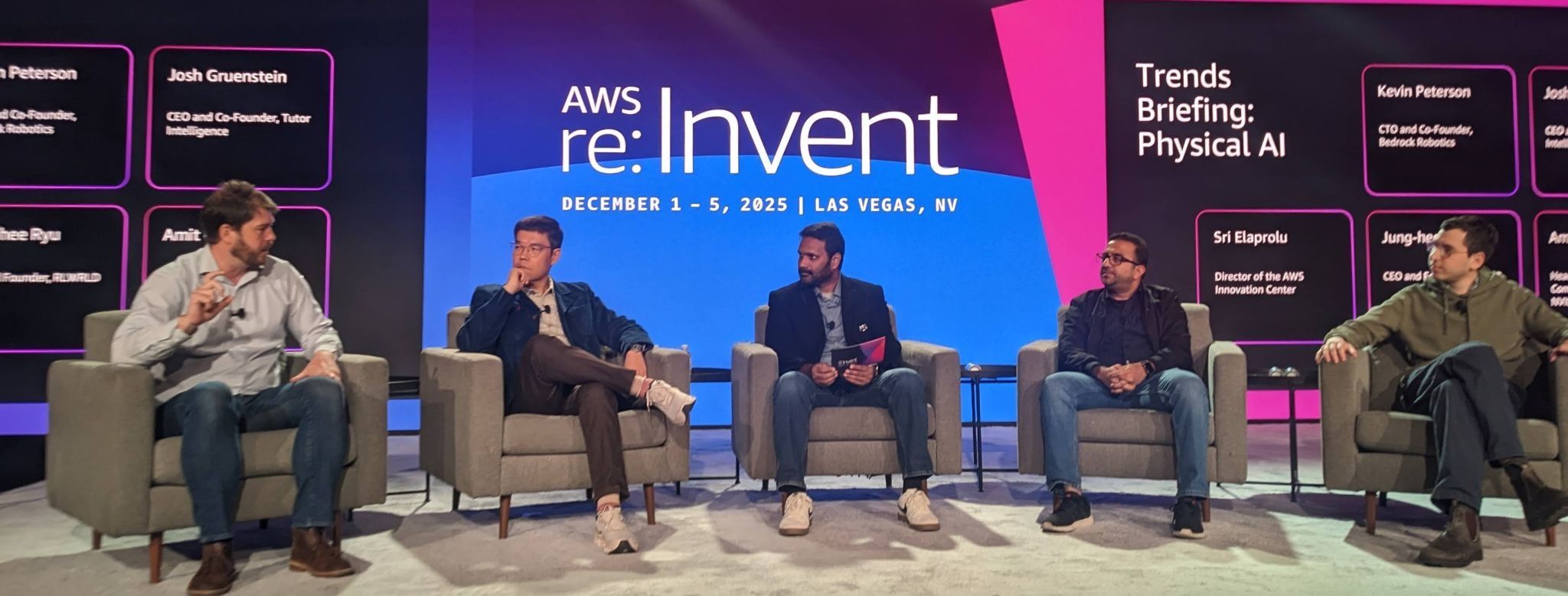
As you may have noticed, AI is moving out of the cloud and into the physical world. AWS and NVIDIA showed off a number of companies building smart robots. This was a varied bunch, from focused companies like RLWRLD building dexterous hands to Bedrock Robotics building real-life Constructicons (they’re powered by Transformers! It counts!). We’ve seen more interest in robots on the podcast, and expect that to continue as technologies improve. Don’t expect robot butlers just yet: consumers are unlikely to spend the $100k that a cutting edge robot like a company will.
All about the platform
What struck me by some of the keynote announcements is that they feel like they are going after some of the same market space as a lot of current agentic startups—security, SRE, and code. In an AMA with Jason Bennett, Vice President, Worldwide Startups and Venture Capital, at AWS, whether they pick companies to support based on whether they compete with AWS features or not. In short, he said it was all about the platform, baby. They want to serve their customers better, and provide tools for anyone to build something better (on AWS, of course).
They announced a number of new computing offerings, many geared towards big hungry AI applications. The new P6e-GB300 UltraServers use the NVIDIA GB300 NVL72, a pretty beefy multi-core rack. EC2 Trn3 UltraServers use a custom-built chip and are specifically designed for training and inference workloads. There were a couple of quality-of-life servers, one with more compute than memory, the other with more memory than compute.
The agentic and AI stuff gets all the headlines, as it rides the zeitgeist pretty hard, but this is where the money is. There’s a saying: “During a gold rush, sell shovels.” In the AI goldrush, these are the shovels. It makes sense that they are pretty competitor agnostic when it comes to AI companies. If they want to run on AWS servers, then consider them a friend.
Naturally, all that software running on AWS servers makes for a pretty appealing attack surface, so they also announced that their Security Hub was generally available. This takes signals from all their security products and correlates them together. This includes GuardDuty, which has been extended to cover EC2 and ECS instances. Taken with the security frontier agent, it seems that AWS knows what a prize they hold and are building better walls against invaders.
Naturally, with all these announcements related to compute, there had to be some related to storage. S3 Vectors are now generally available with two billion vectors per index. S3 maximum object size was increased tenfold. Even old RDS got a little bump to storage.
In talking to folks, I heard a little bit of grumbling about the announcements, that this wasn’t as big a deal as other keynotes. They felt that many of the announcements were of things already available or that added incremental value to existing products. The counter argument was that AWS is essentially feature complete, and anything new should add more reasons to stay with what customers already had.
Actually, it’s not AI; It’s developers
All this agent and AI talk continues to make developers nervous. May Habib, CEO of Writer, told us at a press briefing that CEOs of large enterprises were coming to her asking how they could cut 30% of their workforce. The frontier agents announced in Garman’s keynote will likely not only disrupt and dis-employ SREs and security professionals, they’ll put whole startups out of business. With the growing focus on physical AI, there are more companies looking for new areas in which to automate work.
AWS read the room and addressed these concerns in their keynotes. In Amazon CTO Werner Vogels’s closing keynote—the last of the conference and of his long career—he once again used his shirt to convey a theme. It read, “ Open mind for a different view and nothing else matters,” lyrics from a Metallica song (this being Las Vegas, I heard that there was a bet line on what his shirt would read). He used this speech to talk about the continued need for developers in a changing world, a world that has been continually and rapidly changing since it became a profession.
Like others, Vogels compared AI’s and other technologies’ effect on developers to the Renaissance. It was a time of great advancements in thought and science, and he opined on what made people effective in that world: “They were curious. They questioned assumptions. They learned broadly and applied that learning deeply. They didn't see boundaries between fields. They built bridges between them. They were also bold experimenters. They sketched, they measured. They failed. They tried again. They learned by doing so.”
(There was also a huge amount of societal blowback and violence. Wars sparked by the reformation and counter-reformations swept Europe. The Inquisition tortured and killed plenty of curious free thinkers. While Galileo recanted his views about accepted dogma and dodged execution, Thomas More and Giordano Bruno didn’t. While these curious folks may have not seen boundaries between fields, the people in power certainly did. Don’t mind me, just re-reading Q.)
For a developer to succeed in the future, Vogels gave five qualities:
- Curiosity: Continuous learning has always been part of the developer purview, but I guess it’s grown to include experimenting and failing. Can you add the number of failures to your performance review?
- Thinking in systems: As a dev, you’ll no longer be able to be a hermit in your smaller domain. You’re got to understand where you fit within the larger system.
- Communication: Devs have gotten hip to the power of soft skills in the last few years, especially in remote environments, but Vogels points out that you’ll need to clearly express your thoughts to both teammates and AI tools.
- Ownership: You commit it, you bought it. In a world where it is very easy to create code with AI, devs still need to understand their code, manage the tests and tooling around it, and shepherd it in production.
- Be a polymath: He suggests that having a specialization isn’t enough; you now need to have a solid understanding of the rest of the parts of a software system. I’ve already seen people update their LinkedIn headlines to “T-shaped developer” so it seems the message has landed.
In my conversations with folks, it’s job change, not job loss that’s coming. “Colleen Aubrey and Werner Vogels used the keynote stage to refocus the conversation on where the real benefits lie: growth,” said Pete Johnson, Field CTO, AI at MongoDB. “Not just organizational growth, but the creation of entirely new categories of work, including roles and skillsets that didn’t exist even a few years ago. The message reinforced what many of us are feeling on the ground, that AI is helping to expanding opportunity, not eliminate it.”
The changes coming may have an analogue to the one that came about 20 years (and made the host of the conference a big deal): cloud computing. “People's jobs changed based on what was possible, what was easy, what was hard, and where problems cranked up,” said Michael Foree, Director, Data Platform here at Stack Overflow. “I don't think that jobs are gonna go away. I think that they're gonna radically change, because AI is good at some things, so we don't need people to do X, but it's gonna be bad at some things, so we do need people to step in and do Y. One of the things that I hear frequently is, ‘My job isn't gonna change, but that job over there is gonna change. Like, ‘oh, the data engineers should be worried.’ And then I go, and I talk to a data engineer, and they're like, ‘No, my job is rock solid. Those people over there, they should be concerned.’”
AI may actually create new categories of jobs. While your prompt engineer roles have dried up, there’s a lot of interest in folks who can use AI and agents effectively. “I was talking to a CEO yesterday,” said Parashanth Chandrasekar, Stack Overflow’s CEO. “He’s building a frontier lab for life sciences. That would never have existed a few years ago in the context of what he's doing. It's a complete game changer for him to have access to this kind of end-to-end, integrated tech stack for the AI capability. Overall, there'll be more companies created, and you're seeing that in the startup ecosystem.”
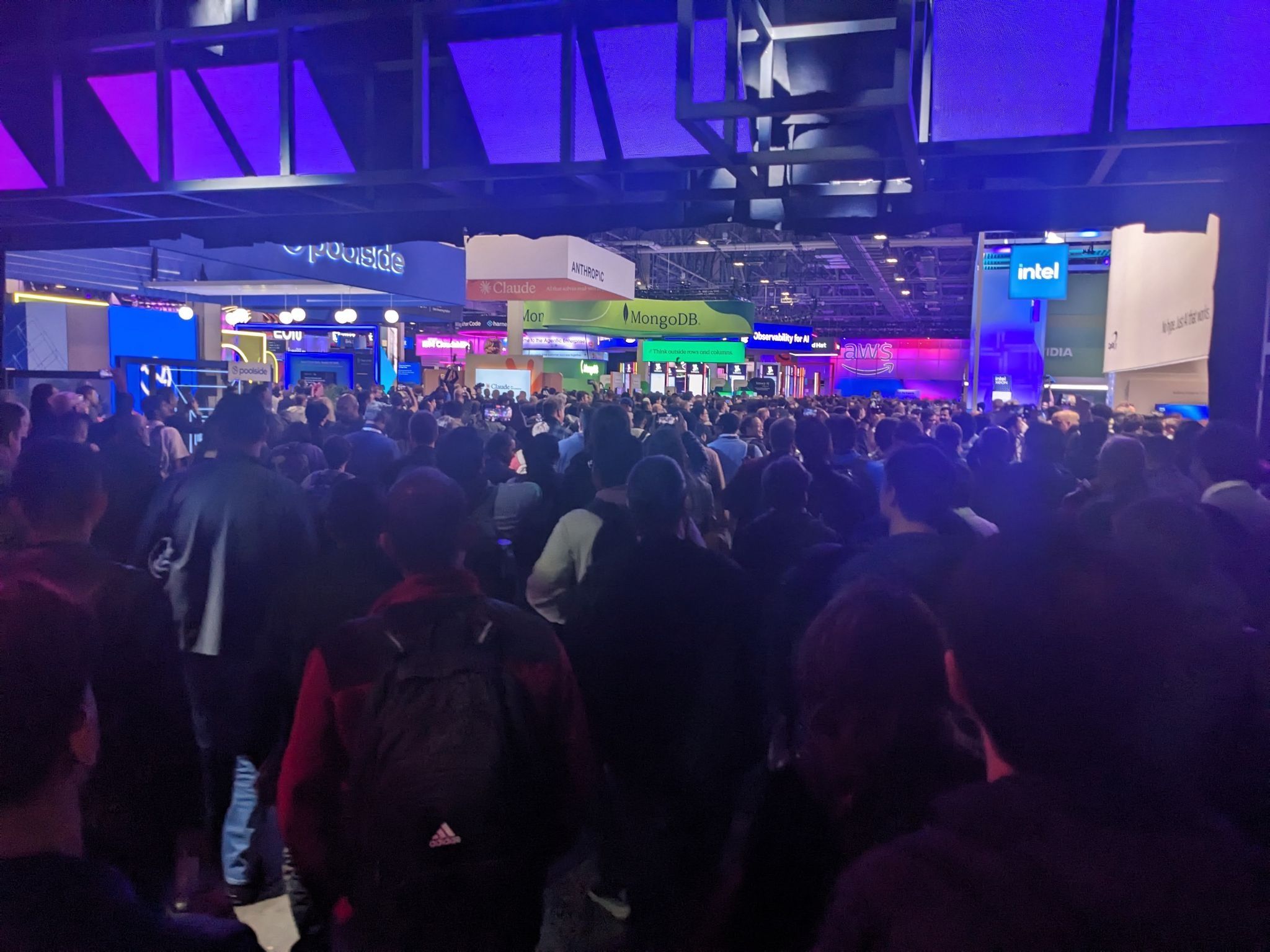
There was no shortage of companies interested in the event. Besides the many companies who shared the keynote stage, hundreds of companies sponsored the event at various levels, and had booths of varying sizes, all staffed with eager and chatty folks. Some of the Expo booths had creative activations: games that drew lines of players and demos that showed off the product. Guests of the Venetian—the primary host of the conference, but not the only one—were handed a list of the five restaurants that weren’t booked by a sponsor for the entire event. As Corey Quinn (of Last Week in AWS fame) put it, “In Las Vegas, the theme and the motto of re-event is ‘Closed for private event’ because every time we try to go somewhere, it's closed.”
AWS is empty and all the devs are here
This being my first re:Invent rodeo (which coincidently shared time with an actual rodeo), I was impressed with the scale and gravity of the thing. Many of the folks I’d talked to for the podcast were on site, as were people I knew IRL. The city seemed consumed by the conference—all the ads were aimed at attendees. The parties were at AWS scale; Beck closed the re:Play party while a robot arm crushed cars in the background. Jack White played a startup event on the first day, while multiple events claimed to have the Chainsmokers on site.

It’s a testament to the centrality of AWS (and cloud computing in general) that this user conference had the gravity to draw 60,000 plus people to Las Vegas. Someone wondered what would happen if there was an AWS outage during the conference. The answer is probably the same as if it happened outside the conference. While there were a lot of AWS employees at the event, speculation was that it was a single digit percentage of the company.
Did you go this year? Let us know what you thought about the show in the comments.