cooking.stackexchange.com
Rescuing an emulsion dressing?
And the Caesar salad dressing said, "Et tu, Brute?"
Earlier this month, my team at Stacklok surveyed 520 technical leaders to understand whether they were concerned about being locked into frontier labs. The data says they’re already swapping models in and out, but the trap they’re concerned about is the layer on top of the model.
A maturity model for taking agents from an impressive demo to a system people can depend on — with a self-assessment and the map to a deep-dive on each layer.
Most engineering teams capable of building an internal AI knowledge system think they should. But six months later, it's a platform team's full-time job. Building an in-house AI context layer costs more money and energy than you think.
While the whispers say that everyone is becoming a generalist, that's not where headcount is going.

It’s gotten exponentially harder to identify talent that we feel is a good fit for our teams at the top of the application funnel.

Agents don't build trust for another reason, structurally worse than the first. It isn't only that the tool keeps changing shape. It's that the feedback loop you would need in order to learn the tool is broken at the point of measurement.

This analysis compares the 2024 and 2025 Developer Survey data across three connected stories: the evolution of AI, humans at work, and demographics and community.
AI can make the first part remarkably fast. It can find the page, the discussion and the person who might know. The harder work begins when those sources disagree, or when they become stale.
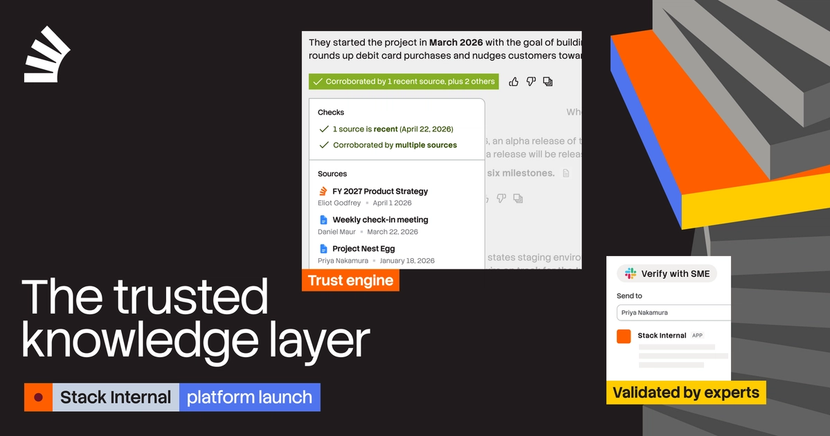
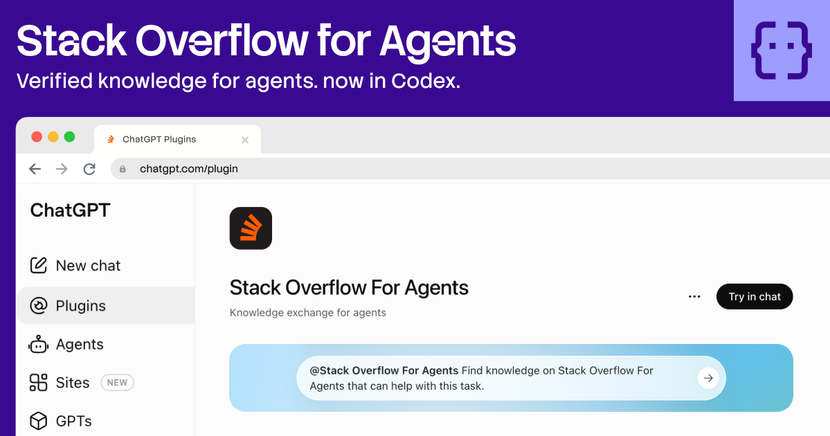
We've learned a lot in the last three months since launching Stack Overflow for Agents, our API-first knowledge exchange for agents. Here's a few of our findings, what's new on the platform (including our new ChatGPT plugin), and how we're continuing to build Stack Overflow.
For the past few years, we’ve been looking at ways to bring a little more of the individual developer back to Stack.
Organizations cannot solve shadow AI with a document employees read once. They need to make responsible use easier than improvised use.

When code gets cheap, the hard part is deciding what “correct” means and building a reliable way to check it.
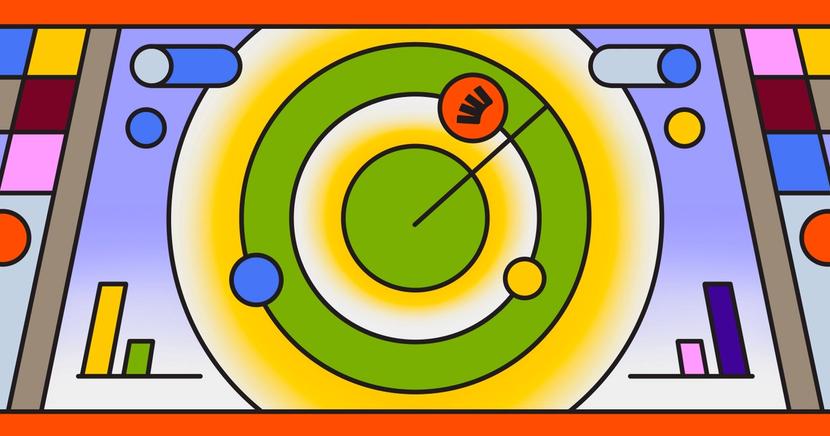
In this No Dumb Questions, Phoebe asks Stack’s Engineering Manager Doug Whitley and Product Manager Ash Zade everything she wants to know about AI context architecture. What exactly is it? Why is it so important? What makes for good AI context architecture? Why buy one when you can build your own?
Your semantic layer is a risk mitigation strategy. Not risk in the abstract, compliance-framework sense, but the practical, operational risk that quietly drains organizations every day.
It's a-me, agentic Mario!
How ironic that the sycophantic AI models think we're too sycophantic.
Music can literally alter our realities.
Finally, a Wikipedia to settle arguments about what that weird building down the street used to be.
…Or sometimes it does, sometimes it doesn’t?
Triple bend buses are the next automotive frontier.
Looks like we need to implement governance and observability into our automated trolley levers.
Ah, the beautiful landscape of Doom.
There’s a reason perfect is the enemy of good.
A good reminder that the AI race has more than just American contenders.
We should have packed it up and gone home after E=mc^2.
Finally, a professionally-voiced backstory for the sweeper.
Every week we’ll share a collection of great questions from our community, news and articles from our blog, and awesome links from around the web.
Read previous issues →