Imagine a customer asks whether your product supports their use case and how it handles their data.
You check the enablement page. It says yes. Someone in support remembers a newer conversation about a limitation. An engineer points out that the answer depends on the customer’s configuration.
You now have three relevant sources and a customer waiting for one answer. Who decides what the company can stand behind?
This happens in every organization. The question could concern a customer, an internal policy or a technical decision. Someone finds the documents. Someone else knows what changed. The group works out an answer, often in a meeting or a chat thread. A month later, another team starts the investigation again.
AI can make the first part remarkably fast. It can find the page, the discussion and the person who might know. The harder work begins when those sources disagree, or when they become stale.
Retrieval has become the starting point
A few years ago, finding the three relevant sources would have been a substantial achievement. Hundreds, if not thousands of products were built entirely around enterprise search, but the needs of customers have completely changed. Teams can connect their tools, search across them, and give a model relevant material to work with within minutes. Hybrid search, chunking, and reranking keep improving and these capabilities are increasingly accessible to teams building their own systems.
Now return to the customer. The enablement page may describe the original functionality. The support discussion may refer to a temporary limitation. The engineer may know a configuration condition that appears in neither source. Retrieving all three gives the team a better starting point but it does not establish which statement applies to this customer today. It does not give them decision-grade knowledge.
This is where many AI experiences lose people. An answer appears quickly and sounds complete. The person receiving it still has to check the sources, find the missing condition and ask a colleague to confirm it. They are doing the last and most consequential part of the work themselves.
That fatigue is reasonable. If an organization wants people to use AI for consequential questions, it has to give them a way to assess the knowledge behind the response.
What the answer needs to carry
For a business-critical question, you need five things before relying on an answer.
- Where did it come from? I need the underlying sources and enough provenance to inspect them.
- When and where does it apply? A correct answer for one product version, region, or customer configuration may be wrong for another.
- Am I allowed to use it? Knowledge must respect the permissions of its sources and the boundaries the organization sets.
- Does anything disagree? If a newer discussion contradicts an older page, the system should help bring that disagreement into view.
- Who can resolve it? Sometimes the answer requires a person who owns the capability or understands the exception.
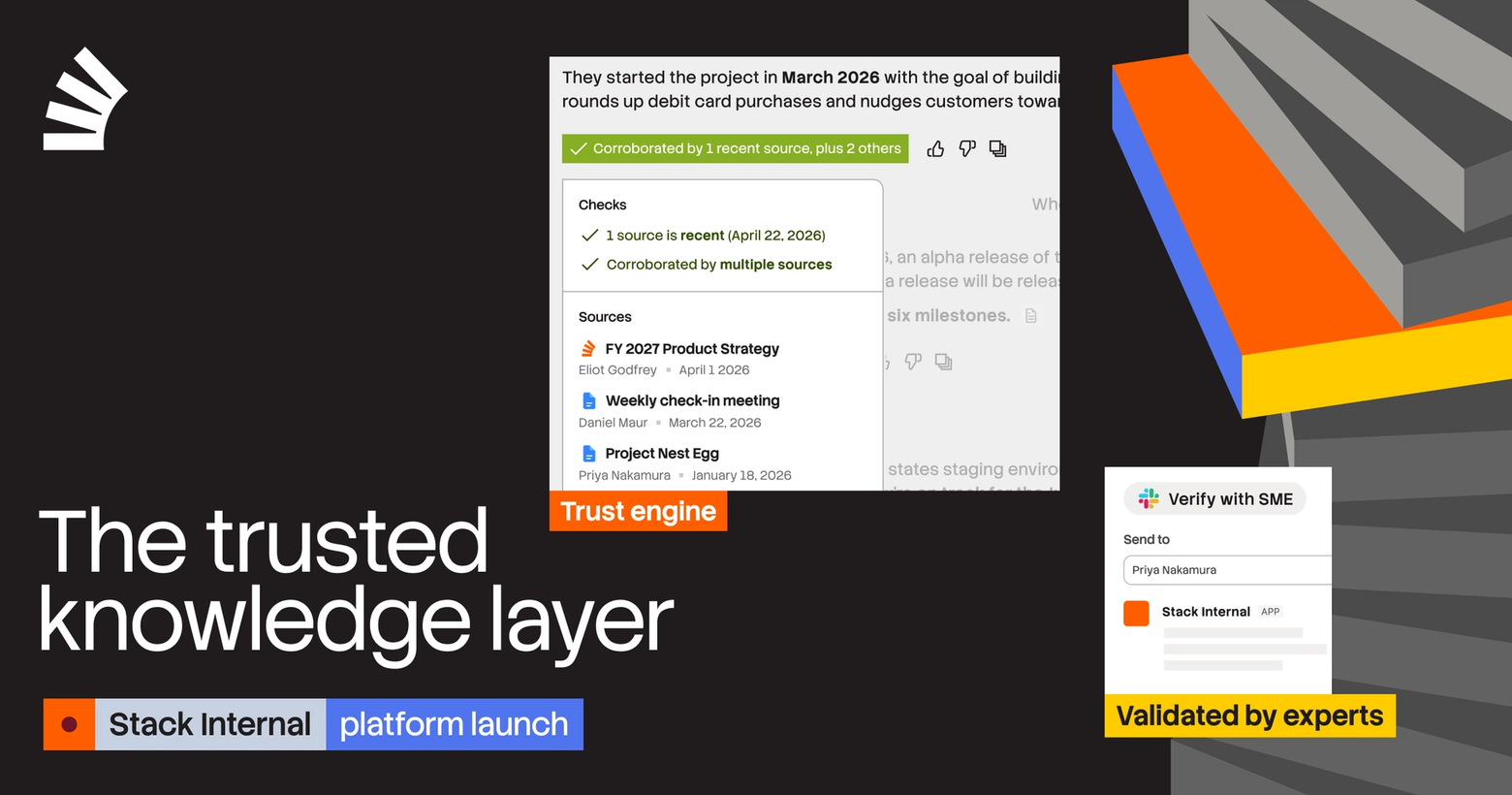
This is what I mean by decision-grade knowledge. People and agents need evidence, context, and a way to improve the knowledge when it changes. Each part affects whether an answer can support a decision.
A citation alone cannot tell the customer which guidance applies. A trust score cannot take responsibility for a product commitment. Both can help the team investigate, but the judgment of people who understand the work still matters.
Put human expertise where it counts
In our example, product can confirm the current capability. Engineering can explain the configuration. Support can tell us what customers are encountering. Each person contributes something the sources alone may miss.
But let’s also be honest here; we do not want those people reviewing every response an AI tool produces. That would create another queue and pull experts away from their work. I want their expertise brought in when a consequential answer is uncertain, when sources conflict or when knowledge used by many people needs validation.
Their contribution also needs to last. Once the team resolves the customer question, the result should include the answer, the conditions under which it applies and the evidence behind it. If something changes, a person should be able to correct it. The next team should start with that work already done.
AI has a useful role throughout this process. It can retrieve and compare sources, help identify gaps, and make validated knowledge available in the next workflow. People establish meaning and resolve the cases where the organization has yet to reach an answer. That is how we want humans and AI to work together on knowledge.
Why we built Stack Internal this way
Stack Overflow has spent nearly two decades learning what happens when people share expertise in a form others can find, examine, and improve. An answer is useful. A correction makes it more useful. The history of that work helps the next person assess what they have found. Stack Internal Community brought those practices inside organizations.
Today we are opening the Stack Internal platform to more people and teams. We are bringing knowledge from an organization’s sources into a shared layer, preserving the context needed to use it responsibly, and making it available through chat, API, and MCP. Subject matter experts have a role in validating and correcting knowledge that others depend on. That role is intentional and is respectful of their time and effort.
The same customer question may come from a person using chat, an internal application using the API, or an agent using MCP. The organization needs a consistent basis for the answer across those experiences. The interface can change. The sources, access rules, and human contributions need to be carried through.
Our companion launch post covers the full capabilities available today and how to get started. I wanted to explain the product decision behind them: we are building for the point where an organization has to decide what it knows, who can use it, and how that knowledge changes.
The next question we are working on
The team resolves the customer question. Product confirms the functionality, engineering explains the configuration, and support identifies the exception. Six months later, the functionality changes.
We need the earlier answer to be correctable. We also need a better way to keep what the team learned in the first place.
Think about how often useful knowledge is created in a one-to-one conversation. Someone works through a difficult question with a colleague or an AI agent. They compare sources, discover an exception, and reach a conclusion. The session ends. That conclusion may never become available to anyone else.
We are already working on ways for people and agents to push useful knowledge back into Stack Internal through the tools where they work. The person contributing it should be able to decide what is worth keeping and who can access it. An expert’s correction should remain connected to the guidance it corrects. Over time, we want the system to help turn resolved conversations into reusable knowledge, identify when sources conflict, and bring the right person in when an answer needs attention.
Knowledge flows to a person or agent when they need it. What they learn can flow back, with evidence, ownership, and appropriate access. The next answer starts from the work already done.
Eventually, we want Stack Internal to help before someone knows which question to ask. It should surface a relevant decision, an unresolved conflict, or a gap that could affect the work in front of them. We have a lot to prove and build before we reach that point and will share more as we go.
Our goal is organizations where a hard-won answer does not disappear with the meeting, chat thread, or AI session that produced it. Each decision and correction should make the next one easier.
Create a free workspace to explore Stack Internal and stay tuned for what comes next.