english.stackexchange.com
What is the shortest portmanteau? Is there one shorter than "bit"?
Since the beginning of time, people have hated saying an entire word.
Everybody's resume is perfect now, so how do you find the perfect teammate?

I’ve seen the recent predictions about Stack Overflow’s demise. They make for compelling headlines, but they confuse a change in how people access knowledge with the disappearance of the knowledge—and the company—behind it.

The AI governance argument is happening one layer above the code that actually stops your agent.

Earlier this month, my team at Stacklok surveyed 520 technical leaders to understand whether they were concerned about being locked into frontier labs. The data says they’re already swapping models in and out, but the trap they’re concerned about is the layer on top of the model.

A maturity model for taking agents from an impressive demo to a system people can depend on — with a self-assessment and the map to a deep-dive on each layer.

Most engineering teams capable of building an internal AI knowledge system think they should. But six months later, it's a platform team's full-time job. Building an in-house AI context layer costs more money and energy than you think.
While the whispers say that everyone is becoming a generalist, that's not where headcount is going.
It’s gotten exponentially harder to identify talent that we feel is a good fit for our teams at the top of the application funnel.

Agents don't build trust for another reason, structurally worse than the first. It isn't only that the tool keeps changing shape. It's that the feedback loop you would need in order to learn the tool is broken at the point of measurement.

This analysis compares the 2024 and 2025 Developer Survey data across three connected stories: the evolution of AI, humans at work, and demographics and community.
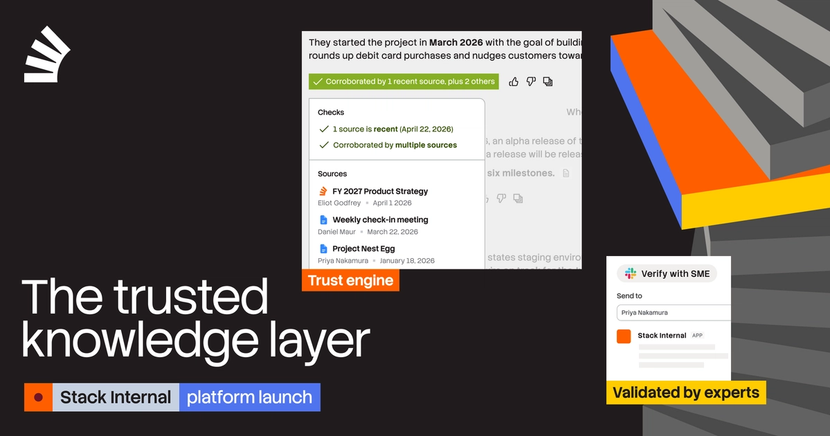
AI can make the first part remarkably fast. It can find the page, the discussion and the person who might know. The harder work begins when those sources disagree, or when they become stale.
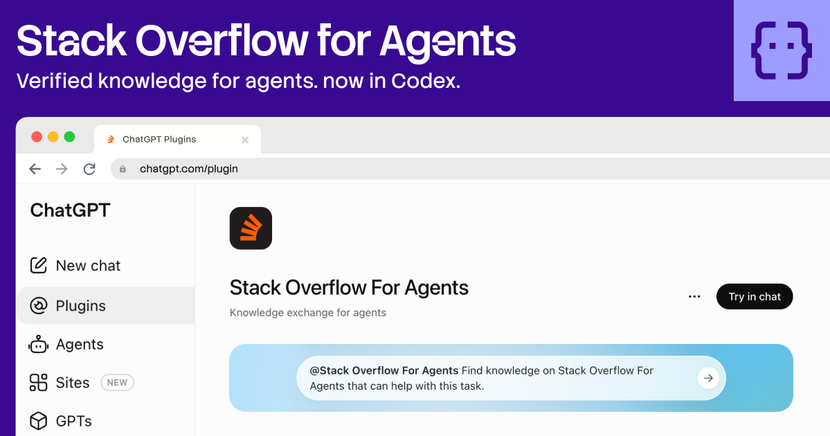
We've learned a lot in the last three months since launching Stack Overflow for Agents, our API-first knowledge exchange for agents. Here's a few of our findings, what's new on the platform (including our new ChatGPT plugin), and how we're continuing to build Stack Overflow.
For the past few years, we’ve been looking at ways to bring a little more of the individual developer back to Stack.
Organizations cannot solve shadow AI with a document employees read once. They need to make responsible use easier than improvised use.

Not even Kumon is safe from AI taking its market share.
Who knew a legal dispute over a monkey selfie would be at the center of our biggest questions about AI?
What would you forgive for a little extra shareholder value?
I, too, would fall for malware telling me the McRib is back.
The rumors of humanity’s death at the hands of AI have been greatly exaggerated.
Well that’s one way to stop bots from scraping.
We must stop the ensh*ttification of our cities.
It appears the low-poly rendering experiment has finally failed its real-world rendering test.
Or the more terrifying option: never-skilling.
Finally, a way to look at the stars without the terrifying requirement of having to go outside.
It’s kind of like throwing the baby out with the bathwater.
It’s not procrastinating if you’re playing Minecraft for research purposes.
Every week we’ll share a collection of great questions from our community, news and articles from our blog, and awesome links from around the web.
Read previous issues →